

Your English Proficiency Tests Guide
The English proficiency test is one of the required tickets to your university destination. There are 4 types of English tests, IELTS , TOEFL iBT, PTE and DUOLINGO. Your university and major determine what English test to take.
All the English proficiency tests examine your 4 abilities, reading, writing, listening and speaking skills.
All the tests must be Academic and the Scores are valid for TWO years.
(If you want to apply for IELTS, TOEFL iBT, PTE and DUOLINGO )
Universities’ Minimum Scores
| University / Major | Minimum English Requirements |
|---|---|
| BUE |
|
| University of London - EUE |
|
| New Giza University Medicine |
|
| Dentistry / Economics / Engineering / IT |
|
| TKH (Coventry) |
|
| University of Hertfordshire - GAF Physiotherapy / Pharmacy |
|
| AUC |
|
What is the PTE Academic Test?
Pearson Test of English (PTE) is an English placement test accredited by over 3,900 universities and colleges globally. It is a 2-hour computer-based test assessing reading, writing, listening, and speaking competence.
The test is divided into 3 parts:
Part 1: Speaking & Writing (9 Question Types)A 60-word text will appear on the screen and you will have 30 to 40 seconds to prepare to read it. When you hear the short tone (beep), you need to read it out loud and finish it before “Recording Complete” appears on the screen.
- Do not start speaking before you hear the short tone, beep, as it will not be recorded.
- Do not rush yourself. Most importantly, speak clearly and confidently.
- You can only record your response once.
Tests listening and speaking. Hear a short sentence and you have 15 seconds to repeat it. The audio plays automatically and recording starts immediately after it finishes.
You have 25 seconds to study and prepare. Describe the image in detail in 40 seconds after the beep. You can answer it once.
Tests listening, speaking, and summarizing. Hear a lecture (up to 90s) and have 10 seconds to prepare and recall information in a summarized way. Speak immediately after the beep.
Hear a question (and potentially see an image). You have 10 seconds to answer with one or a few words.
Hear 3 people discussing a topic for up to 3 minutes. You have 10 seconds to prepare and 2 minutes to summarize it.
Listen to and read the same situation. Have 10 seconds to prepare and 40 seconds to answer.
Evaluate reading, writing, and summarizing. Write a summary of a 300-word text in one sentence within 10 minutes.
Write an argumentative essay (200 to 300 words) about a given topic in 20 minutes.
- Fill in the Blanks: General comprehension.
- Multiple Choice, Multiple Answers: Read with focus and select all possible answers.
- Reorder Paragraph: Put text blocks in order.
- Fill in the Blanks (Drag and Drop): Use provided words to fill gaps (not all words will be used).
- Multiple Choice, Single Answer: Read attentively and select only one answer.
Hear audio (60-90s). Have 10 minutes to summarize in 50 to 70 words.
- Multiple Choice, Multiple Answer: Pick correct answers based on audio.
- Fill in the Blanks (Type in): Fill gaps according to what you hear. (Note: You can use the noteboard).
- Highlight Correct Summary: Read summaries and pick the best one. (Note: You can use the noteboard).
- Multiple Choice, Single Answer: Listen and choose the best fit.
- Select Missing Word: Pick the answer that replaces the "beep" at the end of audio.
- Highlight Incorrect Words: Highlight transcript words that differ from audio.
- Write from Dictation: Hear a short sentence and write it. (Note: You can use the noteboard).
You will receive your score report within 48 hours.
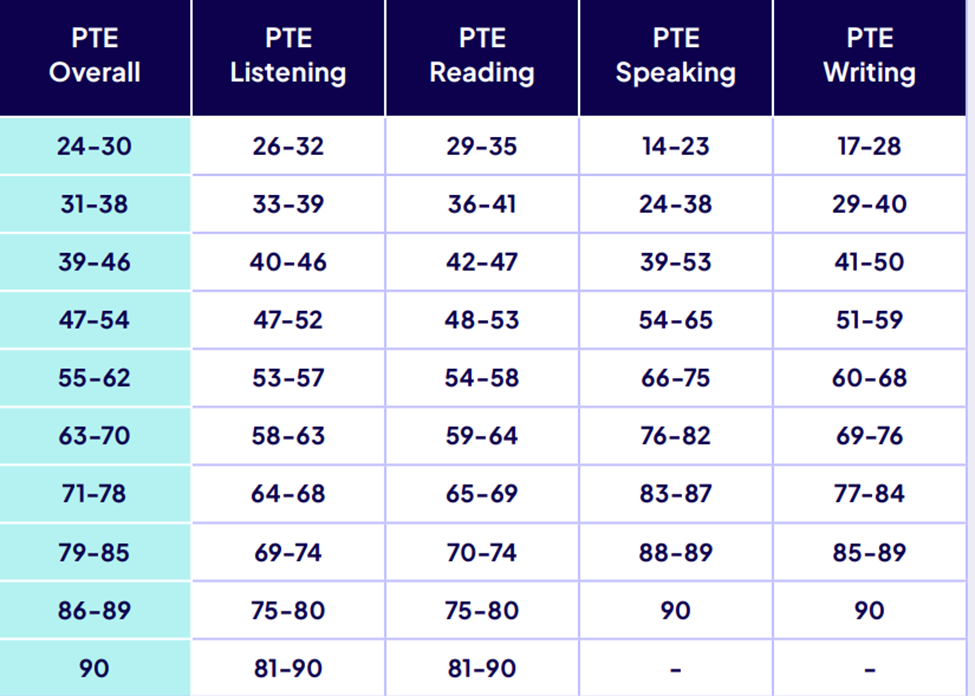
| Education Level | Minimum Score Required |
| Foundation courses | 36 – 50 |
| Undergraduate degrees | 51 – 60 |
What is the TOEFL iBT Test?
TOEFL iBT is an English proficiency test recognized by over 13,000 institutions in more than 200 countries. Owned by ETS, the test lasts approximately 2 hours (116 minutes) and examines reading, writing, listening, and speaking.
Fill in missing letters for 10 provided words within a 70–100 word passage.
A non-academic passage (15–150 words) such as a poster, menu, email, news article, or invoice. You must answer two to three questions based on the text.
Answer five questions about an academic text. This part requires you to infer information that is not explicitly stated.
- Listen and Choose a Response: 10 to 15 questions.
- Listen to a Conversation: Hear a clip (under 1 minute) and answer two questions.
- Listen to an Announcement: Hear a clip (under 1 minute) and answer two questions.
- Listen to an Academic Talk: Hear a topic (History, Art, Science, Business, etc.) and answer four questions.
Rearrange words to put a sentence in the correct grammatical order.
Respond to an academic or social scenario (e.g., making a recommendation or invitation) for a specific purpose.
- Time limit: 7 minutes.
- Focus on: Punctuation, capitalization, and spelling.
Review a professor's question and two student responses. Express and support your own opinion on the topic.
- Time limit: 10 minutes.
- Focus on: Punctuation, capitalization, and spelling.
Repeat 7 statements that gradually become longer and more difficult.
Answer 4 questions individually. You have 45 seconds to respond to each.
What is the IELTS Exam?
IELTS is an English exam assessing proficiency in reading, writing, speaking, and listening. Accredited by 12,500 organizations across 140+ countries, the test lasts for 2 hours and 45 minutes.
Texts are extracted from books, journals, magazines, newspapers, and online resources. At least one text may contain diagrams, graphs, or illustrations. Simple dictionary definitions are provided for technical vocabulary.
- 1. Multiple Choice: Questions follow the order of information in the text. Note: Focus on spelling/grammar during transfer.
- 2. Identifying information (True/False/Not given): Contradicting info is 'False'; missing info is 'Not given'.
- 3. Identifying writer’s views (Yes/No/Not given): Contradicting info is 'No'; missing info is 'Not given'.
- 4. Matching Information: Skim and scan to find specific info within paragraphs.
- 5. Matching Headings: Match headings to paragraphs. Note: There are more headings than paragraphs; focus on the main topic.
- 6. Matching Features: Find connections between options.
- 7. Matching Sentence Endings: Complete a sentence by choosing the best ending from a list.
- 8. Sentence Completion: Fill blanks according to instructions. Note: Word limits are strict; hyphenated words count as one word.
- 9. Summary/Note/Table/Flow-chart Completion: Answers usually come from one specific part of the text.
- 10. Diagram Label Completion: Label visual information.
- 11. Short-answer Questions: Use words directly from the text.
Includes four parts with 10 questions each, organized in the order of the recording. Parts 1 & 2 cover everyday social situations; Parts 3 & 4 cover educational/training situations.
- 1. Multiple Choice: Select the correct answer.
- 2. Matching: Match items from the recording to options on the paper.
- 3. Plan/Map/Diagram Labelling: Complete visuals based on what you hear.
- 4. Form/Note/Table/Flow chart/Summary Completion: Fill gaps from the recording within word limits.
- 5. Sentence Completion: Summarize important information from the text.
- 6. Short-answer Question: Write short answers based on the recording.
Describe visual information (graph, chart, diagram) in at least 150 words.
Discuss a point of view, argument, or problem in at least 250 words.
A recorded, face-to-face interview divided into three parts.
- Part 1 (4-5 mins): Introduction and questions about familiar topics.
- Part 2 (3-4 mins): Talk about a specific topic from a task card. You have 1 minute to prepare (pencil/paper provided).
- Part 3 (4-5 mins): Discussion with the examiner about issues relevant to the Part 2 topic.
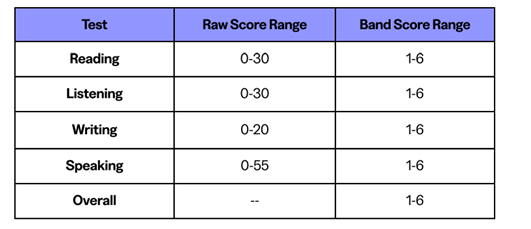
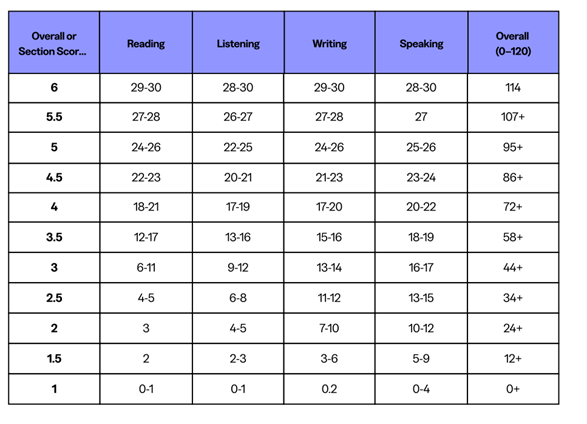
| Band Score 5 | Listening 16 |
| Band Score 6 | Listening 23 |
| Band Score 7 | Listening 30 |
| Band Score 8 | Listening 35 |
| Band Score 5 | Reading 15 |
| Band Score 6 | Reading 23 |
| Band Score 7 | Reading 30 |
| Band Score 8 | Reading 35 |
What is the Duolingo English Test?
Duolingo is an English Placement test that is accepted in more than 6,000 institutions globally. The test is a one-hour assessment and is available online only. It consists of 8 sections.
Yes or No Vocabulary: This section has 15 to 18 questions that ask you “Is this a real English word?” and you select “YES” or “NO” based on your intuition and meaning.
It tests your vocabulary knowledge in context. In this exercise, you need to identify what word suits best.
Type What You Hear: Evaluates your listening and writing skills.
- You can replay it 3 times.
- You do not lose points for taking longer or if the time runs before submission.
- Focus on punctuation, capitalization and spelling.
Complete the Text: Guess the correct words from the first letters that are given.
Facing 5 different question types based on a passage:
- Question 1: Select the best option for each missing word.
- Question 2: Select the best sentence to complete the passage.
- Question 3: Highlight the answer that matches best with the question.
- Question 4: Choose the main idea the passage is talking about.
- Question 5: Pick the best title for the passage.
- First part: Listen and answer.
- Second part: Listen and select the answer.
- Third part: Summarize the conversation.
Part 1: Describe the image provided in 1 minute.
Part 2: Write about a topic in 5 minutes, followed by a 3-minute follow-up response.
Part 1: Describe the image in 90 seconds.
Part 2: Speak about a topic for 90 seconds.
Part 3 (Conversation): Includes 6 questions with 35 seconds to answer each.
First part: Write about the topic for 5 minutes.
Second part: Speak about a topic for 3 minutes.
All scores are on a scale of 10–160. Certified tests receive subscores that measure your proficiency in specific areas.
